Earlier this year, SACA raised two incidents with SBS Transit concerning close shaves by cyclists in quick succession. SBS Transit responded by inviting SACA to a discussion to better understand the issues.
Before that meeting, I met up with Ling and Ai LIn from SACA at a coffee shop in Holland Village. We discussed the fact that serious encounters with bus captains will get reported and be widely discussed in cycling circles. However, positive incidents like this post, "Leeway for cyclists." are not half as exciting and ussually not written or not as well popularised. This imbalance reinforces the idea that bus captains are a threat to cyclists.
Is this actually true across the board?
I doubt that for I have often seen Bus Captains give way to me, slow down, give me wide berth when traffic is light or wave me ahead when pulling out from bus bays to indicate they've spotted me. I have observed many on these incidents through my rear-view mirror.
Admittedly there are Bus Captains, like other motorists, who are unfamiliar with cyclists, and be unable to judge a cyclists speed, or appreciate how it is relatively difficult to brake to avoid a vehicle swerving into our paths. These require education and this can be dealt with in training.
For the minority who are errant, a reporting procedure to deal with this has been established. Thankfully no incidents of this nature have arisen since.
Another issue we discussed was the fact that cyclists are often are a threat to themselves, and thus to other road users. I, for one, feel that a cyclist who intends to ride on our roads amongst traffic should be armed with a rear-view mirror and be familiar with the highway code. Many cyclists are not as well prepared for our traffic-laden roads as they should be.
So SACA put up this SACA-SBS Transit Programme page for starters. By briefing their drivers after receiving this feedback, SBS Transit is improving the situation from their end. And feedback can be incorporated into Bus Captain training in future. And serious incidents will be given their due attention.
Educating cyclists, on the other hand, will be more of a challenge - we lack any organisational structure. While there are ideas about how to improve that, for now, this SACA webpage is a start.
If you have points for the feedback to Bus Captains/motorists or to cyclists, you can leave your comments here to be forwarded to SBS Transit, or email SACA.
Wednesday, May 10, 2006


Wednesday, March 29, 2006
Commute by bike
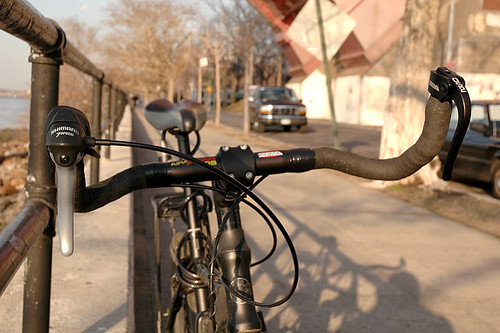
nice story to share about cycling to work...
http://commutebybike.com/2006/03/27/the-new-york-commuter-nick-james/
In late December, the local news began covering the contract dispute between the Metropolitan Transit Authority and the Transit Workers Union, and the possibility of a strike by subway and bus operators. A lot of friends and co-workers were confident that the strike wouldn’t happen, but I wanted to be prepared. On Monday, December 19th, I put on several layers of clothing and some cold weather gear, hopped on my bike, and rode to work. Having proved to myself that I was capable, I concluded that I was prepared for a strike. The next day, the strike was on.
Biking in sub-freezing weather proved easier than I had expected. I anticipated burning wind, icy roads, numb extremities, and other unpleasantries, but learned over a few days of trial and error some of the basic do’s and donts of winter biking, the most important of which was not to overdress, which I did at the start. I also found, somewhat to my surprise, that I enjoyed it. Since you guys at CbB have done a fine job cataloging all the joys of commuting by bike, I won't waste my time listing them. I expect we're all very familiar with them. Suffice it to say that they were new to me.
The transit strike lasted only four days, but it gave me a new resolve. When one transportation option was taken away, I was forced to find another, and the alternative turned out to be the preferable option. So, when the trains started running again, I didn’t get on, and I don't regret it. Commuting by bike has made me stronger, faster, leaner and smarter. It's burned my lungs, strained my knees, torn my rotator cuff, and toughened me up in a hundred little ways. My wife sure likes what it's done to my butt. My co-workers, who at first were impressed and confused, have come to accept it as normal, even to the point of buying bikes and riding to work themselves. Now, having started in the dead of winter, I'm looking forward to the warm weather and sunshine that most cyclists consider "biking season."
I don't think there's anything difficult or special about what I did. Lots of people bike more than 75 miles in a week, and I’m no athlete. Make anything a part of your daily routine and you stop seeing it as a challenge.
I encourage anyone still debating their options to try it out. If it’s not possible, you'll know, but you might surprise yourself.
.....................
more story can be found here
http://commutebybike.com
Thursday, March 16, 2006
Low stress route makes for a joyful bike ride
Joyful? By bicycle? In Singapore? On the roads?? Yes! Let me explain.
My daily ride to work has become a joy since I found a low stress route to take. It takes me mostly along quiet streets. These stretches are linked up by some short off-road short cuts (and a few short stretches of busy roads). Riding to work is now a real pleasure.
The 'short cuts' involve places where I need to dismount to deal with a few steps or clamber up or down a slope. Maybe that sounds annoying but IMHO these inconveniences are a small price to pay to help me avoid the heavy traffic, lorries, noise and fumes of the main alternative route, which includes Alexandra and Pasir Panjang Roads.
You might think all the hassles with short cuts would take more time. But no! The low stress route takes me less than 25 minutes door to door (about 5 or 6 kms). The main road route is shorter and flatter but takes 25 minutes as well, mainly because it has more traffic lights to wait at.
Below I will give details of the route. But first I want to explain why I am sharing this. Why should you be interested in this route if you live nowhere near it?
One reason is to make the point that riding in Singapore is NOT always unpleasant and dangerous. My daily commuting ride is mostly very pleasant, relatively safe and leaves me feeling calm and happy.
Another reason for sharing this is that I hope to encourage you (Singapore cyclists) to share your own useful short cuts. I have often wished for a map of 'secret' ways to avoid dangerous stretches of road when I am out cycling in unfamiliar territory. So much so that I once started to make my own such maps. I might try again if enough people share their short cuts and low-stress bicycle routes! And, at risk of getting carried away with enthusiasm, if we can find and map enough safe routes all over the island, maybe we can persuade the LTA, URA and NParks to improve and protect them and one day link them up into a national bicycle network. Why not?
My route to work
Here is a brief summary of the route. Just the basic facts so you could find it if you wanted to.
- Depot Rd (traffic not too bad usually) turn right (north) into Alexandra Rd (very busy - but on it for a just short stretch)
- turn left (west and up the only serious hill of the trip) into York Rd (in quiet leafy Alexandra Park) (map)
- turn right into Canterbury
- then left into Russels (becomes Winchester)
- then right into small blocked road before Tennis Courts (map)
- left onto grass at the end, dismount, carry bicycles and clamber carefully down steep slope towards AYE. Cross drain - be careful not to fall in! (this bit may put some people off)
- left along 'goat track' that has been worn by pedestrians and bicycles running along AYE (on the safe side of the crash barrier)
- join the Normanton exit from AYE
- at far side of junction dismount and climb steps into Science Park I (at the back of Cintech III) (map)
- turn right into Science Park Drive (some traffic but usually low speed)
- turn left into South Buona Vista (and be careful of the pinch point right near the junction at the star on this map and be wary of the heavy traffic here at peak times)
- continue south along the windy road (by the way, if you instead turn right immediately here you can enter NUS and either ride along the ridge to the Central Library or head down to the Business School past the PGP student accommodation)
- until the first bus stop (you will see a sheltered bus stop on the right for SBS route 200). Cross road (carefully!) and carry bicycle down the stairs into Science Park II (The Gemini) (map)
- turn right into Science Park Rd (down hill - the only serious hill of return trip)
- This takes you to Pasir Panjang Rd, although I turn right again before the Capricorn building to go up to Heng Mui Keng Terrace and my office
The reverse route is more or less the same, but with slightly more inconvenience (walking bike on footpaths in two places for a short stretch rather than ride the wrong way against traffic - which is very very dangerous!).
Please email details of your favourite LOW-STRESS routes and short cuts to sppbpa at nus dot edu dot sg. Please give enough detail so we can find them. I and other friends of 'Cycling in Singapore' blog will try to check them out and then hopefully share them via this blog sometime.
In coming months I will also share some other low stress routes and useful short-cuts that I have found.
Sunday, February 12, 2006
Cycling home - faster than public transport
"Break Even." By Warhammer. Le Tour, 11 Feb 2006.
"At the end of the day got back at 0925. Surprise, surprise, cycling home is 15mins faster then if I had taken public transport!"
"I'm thinking that it'll be quite a good experiment to compare the time taken for cycling, public transport and car from point to point. It should make a good case for cycling as a mode of transportation. I noticed that on roads with a lot of traffic lights keeping pace with a bus is actually not a problem."
Link.
"At the end of the day got back at 0925. Surprise, surprise, cycling home is 15mins faster then if I had taken public transport!"
"I'm thinking that it'll be quite a good experiment to compare the time taken for cycling, public transport and car from point to point. It should make a good case for cycling as a mode of transportation. I noticed that on roads with a lot of traffic lights keeping pace with a bus is actually not a problem."
Link.
Thursday, February 09, 2006
"Cycling track or obstacle course?"
"Cycling track or obstacle course?"
Letter from Elke Eskes-Frey. Today, 09 Feb 2006.Pedestrian bridges along park connector give cyclists a back-breaking experience.
I grew up in an environmentally-conscious nation where people cycle not only to exercise, but also to commute and save energy — even if they have two cars at home. So, perhaps I was spoilt to think that I have rights on the road as a cyclist.
I don't cycle here because of drivers who hoot or push me off the road. I tried in the beginning, but soon found that I am too exposed to the risk of sudden death on the street, and am barely tolerated on the sidewalk. Until recently, I had not found any cycle track outside a park, which made it impossible to cycle with pleasure from one point to another.
But then, a stroke of luck: I picked up a map that informed me of the Government's plan to build a park connector network that will span over 300km once completed for pedestrians and cyclists alike.
I dusted off my bike and went to explore the already-completed Kallang and Whampoa connector. I could see myself riding, long hair blowing in the wind, along parks and canals.
But I ended up finding myself carrying the bike on my back, up and down one pedestrian bridge after another, finally reaching the Toa Payoh bridge with its six flights of stairs (or was it only five?).
My hair got covered in sweat and car fumes and could not even dry out in the short cycling stretches between the crossings.
Don't get me wrong — the ride was fun and educational. I learned about the concept of having numerous "No riding on bicycle" or "Get off bicycle" signs on a cycle track!
And I now know that Singapore's new park connector "caters to cyclists who prefer longer distances" — and especially to those who prefer carrying their beloved bike around for even longer ones.
Letter from Elke Eskes-Frey. Today, 09 Feb 2006.Pedestrian bridges along park connector give cyclists a back-breaking experience.
I grew up in an environmentally-conscious nation where people cycle not only to exercise, but also to commute and save energy — even if they have two cars at home. So, perhaps I was spoilt to think that I have rights on the road as a cyclist.
I don't cycle here because of drivers who hoot or push me off the road. I tried in the beginning, but soon found that I am too exposed to the risk of sudden death on the street, and am barely tolerated on the sidewalk. Until recently, I had not found any cycle track outside a park, which made it impossible to cycle with pleasure from one point to another.
But then, a stroke of luck: I picked up a map that informed me of the Government's plan to build a park connector network that will span over 300km once completed for pedestrians and cyclists alike.
I dusted off my bike and went to explore the already-completed Kallang and Whampoa connector. I could see myself riding, long hair blowing in the wind, along parks and canals.
But I ended up finding myself carrying the bike on my back, up and down one pedestrian bridge after another, finally reaching the Toa Payoh bridge with its six flights of stairs (or was it only five?).
My hair got covered in sweat and car fumes and could not even dry out in the short cycling stretches between the crossings.
Don't get me wrong — the ride was fun and educational. I learned about the concept of having numerous "No riding on bicycle" or "Get off bicycle" signs on a cycle track!
And I now know that Singapore's new park connector "caters to cyclists who prefer longer distances" — and especially to those who prefer carrying their beloved bike around for even longer ones.
Monday, February 06, 2006
GOOD things about Singapore for cycling?
The other day as I cycled home from work (and was enjoying it) I started a mental list of some of the GOOD things for bicycle users about Singapore and its road system.
Maybe a list of problems springs more easily to mind? People who don't even cycle all seem to have a long list! The heat, humidity, the danger from those 'crazy Singapore drivers', the rain, etc. Did I mention the heat?
Even we cyclists are sometimes not the best ambassadors for our favourite mode of transport. It doesn't take much to trigger from the average commuter cyclist a rant about high speed traffic, inconsiderate motorists or bus drivers, parallel drainage grates, the high density of heavy vehicles, the dangers of multiple left-turn lanes, those crazy (other) cyclists who give us all a bad name, etc etc etc.
But here I want to be POSITIVE for a few minutes. What ARE the strengths here that maybe we could build on if we hope to make cycling in Singapore a safer and more enjoyable and popular experience?
So here is my start on a "The Good Things about Singapore for Bicycle Users". I hope you will add to or improve on this.
* Kerbside parking is rare here. Singapore's bicycle users may not realise how nice this is. Where I come from, there are cars parked along almost every road and street, which takes a lot of skill to handle. Believe me, the relative lack of on-street here is great!
* Smooth road surfaces: we have a high quality road network with very few potholes, repairs made quickly, and a generally pretty high standard for the smoothness of repairs after the roads get dug up
* The weather! Yes, the weather. No I am not delusional. Let me explain. It could really be a lot worse. Try telling northern Europeans that they have the perfect climate for cycling.
OK it rains here but where doesn't it rain? At least the rain here is usually brief. And it is lovely and warm even if you do sometimes get soaked.
And the heat? Well, most of my riding to and from work is in the morning and evening when it is amazingly cool. Even when I ride at midday I find that it is pretty comfortable, at least while I am moving along, with the breeze blowing over me. Walking any distance (eg to and from the bus stop) is just as hot. Worse actually, because then I am usually wearing office clothes. Cycling activists in places like Canada that face some extremes of weather say there is no such thing as bad weather for cycling, just inappropriate clothing and lack of facilities. [entering whistful dream mode... If only Singapore had a lot more showers in workplaces ... ]
I nearly forgot to mention the wind. It is windy right now and usually is in late January and early February but Singapore is usually not a windy place. Having cycled a lot in Perth, Western Australia, I know that the wind can be very discouraging.
* Short distances. OK, this depends where you are and where you want to go of course. But generally, from almost anywhere in Singapore you have a large number of useful destinations within 6 kilometres which is no more than a 25 minute ride at a pretty easy pace.
* The public transport system. Why is this relevant? Yes, maybe you are scared of those huge double-decker buses and the long bendy buses but my point here is that a good public transport system, especially the MRT, is a perfect complement to a bicycle. Thousands of Singapore residents have already realised this fact, judging from the number of bicycles parked at MRT stations and bus interchanges, especially in the east and north of the island. And with a folding bicycle (go Chuwa!!) bike-MRT-bike trips become attractive. Getting to the nearest MRT station is almost always faster on a bicycle than by a feeder bus. [If only we could take full size bikes on the MRT ... at least in off-peak times, sigh...]
* The cheap taxis. When some of them are not menacing us on the road, they come in very handy to get us home after a late night, a puncture, or if you are just too exhausted to face the ride back again. Not many rich cities have such affordable taxis. And most taxi drivers seem happy to toss a bicycle in the boot when necessary.
* The Park Connectors and the bikeways in parks like East Coast Park. Some of these have some problems (eg missing links and some poor design in places) but could be considered to be a very nice start on an islandwide network of safe cycling routes...
* The informal (pedestrian) shortcuts scattered everywhere. Singapore has fewer quiet backstreets than some other places I have lived in but it has more informal shortcuts. With a bit of effort I have found that I can find low-stress routes for many of my favourite destinations, with the help of short pedestrian short cuts here and there. If I ever get my act together I might even start trying to map these again some day.
* Few bicycle thieves. This is relative of course, and I hear that this is a bit of a problem in Tampines and Pasir Ris. But compared with rampant bike theft in many countries we have it pretty lucky here.
* More? It is over to you ... comments?
Maybe a list of problems springs more easily to mind? People who don't even cycle all seem to have a long list! The heat, humidity, the danger from those 'crazy Singapore drivers', the rain, etc. Did I mention the heat?
Even we cyclists are sometimes not the best ambassadors for our favourite mode of transport. It doesn't take much to trigger from the average commuter cyclist a rant about high speed traffic, inconsiderate motorists or bus drivers, parallel drainage grates, the high density of heavy vehicles, the dangers of multiple left-turn lanes, those crazy (other) cyclists who give us all a bad name, etc etc etc.
But here I want to be POSITIVE for a few minutes. What ARE the strengths here that maybe we could build on if we hope to make cycling in Singapore a safer and more enjoyable and popular experience?
So here is my start on a "The Good Things about Singapore for Bicycle Users". I hope you will add to or improve on this.
* Kerbside parking is rare here. Singapore's bicycle users may not realise how nice this is. Where I come from, there are cars parked along almost every road and street, which takes a lot of skill to handle. Believe me, the relative lack of on-street here is great!
* Smooth road surfaces: we have a high quality road network with very few potholes, repairs made quickly, and a generally pretty high standard for the smoothness of repairs after the roads get dug up
* The weather! Yes, the weather. No I am not delusional. Let me explain. It could really be a lot worse. Try telling northern Europeans that they have the perfect climate for cycling.
OK it rains here but where doesn't it rain? At least the rain here is usually brief. And it is lovely and warm even if you do sometimes get soaked.
And the heat? Well, most of my riding to and from work is in the morning and evening when it is amazingly cool. Even when I ride at midday I find that it is pretty comfortable, at least while I am moving along, with the breeze blowing over me. Walking any distance (eg to and from the bus stop) is just as hot. Worse actually, because then I am usually wearing office clothes. Cycling activists in places like Canada that face some extremes of weather say there is no such thing as bad weather for cycling, just inappropriate clothing and lack of facilities. [entering whistful dream mode... If only Singapore had a lot more showers in workplaces ... ]
I nearly forgot to mention the wind. It is windy right now and usually is in late January and early February but Singapore is usually not a windy place. Having cycled a lot in Perth, Western Australia, I know that the wind can be very discouraging.
* Short distances. OK, this depends where you are and where you want to go of course. But generally, from almost anywhere in Singapore you have a large number of useful destinations within 6 kilometres which is no more than a 25 minute ride at a pretty easy pace.
* The public transport system. Why is this relevant? Yes, maybe you are scared of those huge double-decker buses and the long bendy buses but my point here is that a good public transport system, especially the MRT, is a perfect complement to a bicycle. Thousands of Singapore residents have already realised this fact, judging from the number of bicycles parked at MRT stations and bus interchanges, especially in the east and north of the island. And with a folding bicycle (go Chuwa!!) bike-MRT-bike trips become attractive. Getting to the nearest MRT station is almost always faster on a bicycle than by a feeder bus. [If only we could take full size bikes on the MRT ... at least in off-peak times, sigh...]
* The cheap taxis. When some of them are not menacing us on the road, they come in very handy to get us home after a late night, a puncture, or if you are just too exhausted to face the ride back again. Not many rich cities have such affordable taxis. And most taxi drivers seem happy to toss a bicycle in the boot when necessary.
* The Park Connectors and the bikeways in parks like East Coast Park. Some of these have some problems (eg missing links and some poor design in places) but could be considered to be a very nice start on an islandwide network of safe cycling routes...
* The informal (pedestrian) shortcuts scattered everywhere. Singapore has fewer quiet backstreets than some other places I have lived in but it has more informal shortcuts. With a bit of effort I have found that I can find low-stress routes for many of my favourite destinations, with the help of short pedestrian short cuts here and there. If I ever get my act together I might even start trying to map these again some day.
* Few bicycle thieves. This is relative of course, and I hear that this is a bit of a problem in Tampines and Pasir Ris. But compared with rampant bike theft in many countries we have it pretty lucky here.
* More? It is over to you ... comments?
Tuesday, January 24, 2006
Errant cyclists will affect tolerance for riding on pavements
Note: Cycling on pavements is technically illegal. Yet there is tolerance for this generally amongst pedestrians. But bad behaviour put pedestrians at risk and and lower tolerance. Two letters appear this week in the online forum of The Straits Times.
"If road bullies are hauled to court, errant cyclists shouldn't be let off hook." By Marcus Tun. ST Forum (Online Letters) [The Straits Times], 24 Jan 2006.
I write this with reference to the letter 'Take action against cyclists on pavements before accidents happen' (ST Online Forum Jan 20) by Mr Teoh Beng San.
Working in Tampines, where cyclists riding on pedestrian walkways is not an exception, I truly empathise with his situation. Not only do they infest the walkways, frequently there will be those who insist it is their divine right to speed and make sharp turns around the corners of the many office buildings and malls there.
It does not require a genius to know that such corners are blind spots. Yet I have encountered more than a few such instances. Once a colleague of mine just missed being knocked over by a cyclist who appeared around a corner like an aspiring Valentino Rossi.
Not only was he unapologetic, he glared at her before proceeding merrily along his way.
This topic has been revisited ad nauseum. But it was the behavior of the cyclist cited in Mr Teoh's letter that prompted me to come out with this. To think that the errant cyclist had the gall and audacity to be aggressive sickens and infuriates me.
Will he have dared to do this to someone half Mr Teoh's age and may be in a much better physical shape? Not likely.
We see how road bullies are hauled to courts and slapped with fines and jail terms for their callous actions. This cyclist and others like him should not be treated differently.
Hit them hard where it hurts, be it the pocket or something else. I understand the need and clamour for cyclists to have their share of road space but pedestrian walkways and corridors are just not theirs.
Take action against cyclists on pavements before accidents happen." By Teoh Beng San. ST Forum (Online Letters) [The Straits Times], 20 Jan 2006.
I am writing to you because I've had enough of irresponsible, inconsiderate cyclists who turn the pavement for pedestrians into a bicycle lane.
On January 13 evening, I was walking along the pavement at Simei Street 3 on my way to Simei MRT Station. A male Chinese on a bicycle with a woman as pillion-rider passed me from the rear.
After he overtook me, he said in Hokkien 'Ah Pek did not hear the bell'. Sensing that he was annoyed with me for not giving way, I remarked in English that he should not be cycling on the pavement.
I was unable to hear him ringing his bicycle bell as I am 76-years-old and hard of hearing. When he heard my remark, he stopped and confronted me.
He asked me in a threatening manner if I was capable of walking on the road. To my affirmative reply, he arrogantly told me he too can cycle on the pavement.
I tried to make him realise that it was an offence to cycle on a pedestrian pavement but he turned aggressive. It was my good fortune that my daughter-in-law, who was waiting at the roadside, intervened and calmed him down.
I dread to think what could have happened to me if not for the timely intervention of my daughter-in-law.
What is the police doing? What action is being taken against such errant and irresponsible cyclists who are breaking the law and making a mockery of it?
About a year ago, the then Commander of Traffic Police wrote me a letter (and I am sure to other motorists as well) about ensuring 'road safety of more vulnerable road users like motorcyclists, pedestrians and cyclists'.
I would like to ask the police: Now that irresponsible and errant cyclists pose a serious danger to pedestrians by converting the pedestrian walkway into a bicycle lane, who is more vulnerable, the cyclist or the pedestrian?
I suggested in my reply to the then Commander to have a campaign to educate cyclists that they cannot flout the law and pose a danger to pedestrians.
I got a reply saying they will work on my feedback. Alas the situation is worse now. Perhaps only when a pedestrian, especially a child, gets seriously injured or dies because of an errant cyclist will the police take strong action against them.
Copyright © 2005 Singapore Press Holdings.
"If road bullies are hauled to court, errant cyclists shouldn't be let off hook." By Marcus Tun. ST Forum (Online Letters) [The Straits Times], 24 Jan 2006.
I write this with reference to the letter 'Take action against cyclists on pavements before accidents happen' (ST Online Forum Jan 20) by Mr Teoh Beng San.
Working in Tampines, where cyclists riding on pedestrian walkways is not an exception, I truly empathise with his situation. Not only do they infest the walkways, frequently there will be those who insist it is their divine right to speed and make sharp turns around the corners of the many office buildings and malls there.
It does not require a genius to know that such corners are blind spots. Yet I have encountered more than a few such instances. Once a colleague of mine just missed being knocked over by a cyclist who appeared around a corner like an aspiring Valentino Rossi.
Not only was he unapologetic, he glared at her before proceeding merrily along his way.
This topic has been revisited ad nauseum. But it was the behavior of the cyclist cited in Mr Teoh's letter that prompted me to come out with this. To think that the errant cyclist had the gall and audacity to be aggressive sickens and infuriates me.
Will he have dared to do this to someone half Mr Teoh's age and may be in a much better physical shape? Not likely.
We see how road bullies are hauled to courts and slapped with fines and jail terms for their callous actions. This cyclist and others like him should not be treated differently.
Hit them hard where it hurts, be it the pocket or something else. I understand the need and clamour for cyclists to have their share of road space but pedestrian walkways and corridors are just not theirs.
Take action against cyclists on pavements before accidents happen." By Teoh Beng San. ST Forum (Online Letters) [The Straits Times], 20 Jan 2006.
I am writing to you because I've had enough of irresponsible, inconsiderate cyclists who turn the pavement for pedestrians into a bicycle lane.
On January 13 evening, I was walking along the pavement at Simei Street 3 on my way to Simei MRT Station. A male Chinese on a bicycle with a woman as pillion-rider passed me from the rear.
After he overtook me, he said in Hokkien 'Ah Pek did not hear the bell'. Sensing that he was annoyed with me for not giving way, I remarked in English that he should not be cycling on the pavement.
I was unable to hear him ringing his bicycle bell as I am 76-years-old and hard of hearing. When he heard my remark, he stopped and confronted me.
He asked me in a threatening manner if I was capable of walking on the road. To my affirmative reply, he arrogantly told me he too can cycle on the pavement.
I tried to make him realise that it was an offence to cycle on a pedestrian pavement but he turned aggressive. It was my good fortune that my daughter-in-law, who was waiting at the roadside, intervened and calmed him down.
I dread to think what could have happened to me if not for the timely intervention of my daughter-in-law.
What is the police doing? What action is being taken against such errant and irresponsible cyclists who are breaking the law and making a mockery of it?
About a year ago, the then Commander of Traffic Police wrote me a letter (and I am sure to other motorists as well) about ensuring 'road safety of more vulnerable road users like motorcyclists, pedestrians and cyclists'.
I would like to ask the police: Now that irresponsible and errant cyclists pose a serious danger to pedestrians by converting the pedestrian walkway into a bicycle lane, who is more vulnerable, the cyclist or the pedestrian?
I suggested in my reply to the then Commander to have a campaign to educate cyclists that they cannot flout the law and pose a danger to pedestrians.
I got a reply saying they will work on my feedback. Alas the situation is worse now. Perhaps only when a pedestrian, especially a child, gets seriously injured or dies because of an errant cyclist will the police take strong action against them.
Copyright © 2005 Singapore Press Holdings.
Subscribe to:
Posts (Atom)