"Singapore fold-up bike goes against Asian tide," by Gillian Murdoch. Reuters (Features), 20 Dec 2006.
SINGAPORE (Reuters) - Chu Wa feels the small thrill of breaking Singapore's notoriously strict rules and getting away with it every time he wheels his pretend "shopping trolley" through a shopping mall or along a train platform.
The contraption is actually a fold-up bicycle, which Wa designed to look like a shopping cart so he could take it through the many prohibited zones in the city state.
"Singapore is absolutely not fair for cyclists," said the 46-year old product designer.
After years of biking to work in the Netherlands, Wa gave up and bought a car when he moved to Singapore, finding its motorways and shopping malls bike-unfriendly.
"If you love cycling in Singapore, you have to accept the status of a secondary citizen, many places are 'restricted zones' and you are simply not welcome," he wrote on his blog, www.jz88.com.
At the same time as European cities are back-pedalling from cars to bikes in a bid to clean the air and ease congestion, rising affluence has seen bikes ditched from Beijing to Bangkok. Bikes have been banned from parts of Shanghai as have bike rickshaws in Dhaka, and bikers in Jakarta and Bangkok have mounted protests to campaign for better facilities.
The lack of top-level support makes returning to cycling more difficult than it should be, said Wa, who had five regular bikes stolen from unguarded bike stands in Singapore.
His solution? The JZ88: a thief-proof bike that flips from shopping trolley to cycle in 8.8 seconds.
With a shopping bag strapped over its handlebar, and spokes concealed under clear plastic shields, Chu's folding bike goes everywhere he does. Weighing nine kilograms (20 pounds), it is small enough to fit under train seats and in taxi boots.
Shoppers stare as he loads groceries into his trolley, and pedestrians sometimes laugh as his long legs pedal the little wheels. But Wa says his bike is more than a gimmick.
"My ideal is to see more Asian cities become bicycle friendly ... The hurdle is so high, in terms of road safety, too much effort, or bad weather, that even the authorities can't do much," he said. "(But) the folding bike can be a bridge".
FOLDING BIKES
First patented in 1899, a decade after the modern bike was invented, folding bikes have long been a feature in Europe.
While brands like England's Brompton are well known abroad, Hong Kong-born Wa says most people in Asia don't know they exist. His folding bike customers are two-to-one expatriates to locals.
In Singapore, like much of Asia, bikes are seen as poor man's transport, he says.
With a record 117,000 more new cars on its roads this year, Singapore seems to have declared the car the winner in the Asia-wide car versus bike transport battle.
Local lore has it that a car is one of the must-have "5C's" - car, cash, condo, credit card and country club membership. Even the Director of the Singapore Environment Council has called the country a "nation of car lovers".
Government statistics say the proportion of households with cars increased to 32 per cent in 2000, up from 28 per cent in 1990. Bicycles don't feature in future transport plans.
By contrast, London's Cycling Action Plan has chalked up a 72 percent increase in cycling over the past four years. And New York's Bicycle Master Plan is almost doubling its bike lanes over the next three years.
Professor John Whitelegg, who works at the University of York's Air Pollution in Asian Megacities project, says some Asian officials are in denial about the environmental costs of car culture such as air pollution and congestion.
"Unlike in Europe, growing car ownership is seen as very virtuous, in improving quality of life and job creation in car manufacturing and road-building," Whitelegg said.
"It's just part of rapid economic growth and urbanisation, which they associate with removing poverty. And what's happening in China is also happening in Indonesia, Vietnam and Thailand..."
"The economic escalator is so strong nobody can think of a way to get the benefits without the disbenefits".
STARBUCKS FOR BIKES
Despite the odds, a few "rebels" are trying to buck the trend.
In 2005, Singaporean entrepreneurs Alex Bok and Lynton Ong opened the first in a chain of Bike Boutique stores they plan for Hong Kong, Kuala Lumpur, Bangkok, Jakarta, Manila and Australia.
Housed in an old shop-house, the concept store they hope will become the "Starbucks for bikes", charges sweaty bike commuters S$150 a month to store their bikes and take a shower before work.
Customer Mark Goh, says cycling's image problem is a worse barrier than tyre punctures, the tropical heat, or heavy rain.
"The problem with Singaporeans is one of perception, not motivation," the 39-year-old law firm managing partner said.
His colleagues think he is a "clown" for giving up his air-conditioned Mercedes-Benz to pedal half an hour to work.
"They prefer to spend their weekends in air-conditioned malls, eating out and moving about cocooned in air-conditioned cars," he said.
"More importantly, the car you drive is a huge status symbol. It benchmarks your social level. Few would dare proclaim that they own a bicycle as against a German-make car".
FACTBOX - Cycling declines in Asia, on rise in Europe
Dec 20 (Reuters) - Bicycle ownership and use has been declining in China and India, while Europe is at the forefront of measures to popularise cycling. Here are some comparisons:
OVERVIEW
There are some 1.6 billion bicycles in the world, 500 million of them in China, 250 million in Europe and 150 million in the United States.
China and India are the world's largest producers of bicycles. China manufactured about 80 million bicycles in 2005, accounting for about 60 percent of global production while India's share was around 11 percent.
The global bicycle industry, including bicycles, parts and accessories, is estimated to have total retail sales in excess of $20 billion.
CHINA AND INDIA
Annual bicycle sales in China have fallen from 40 million in the 1990s to 20 million. Bicycle ownership in India is down from about 45 million in 1995 to 31 million.
The proportion of trips undertaken by bicycle in India is between 15 percent and 35 percent, but cycling is popular mostly in rural areas. The absence of safe cycling paths and parking facilities are the major obstacles.
Sixty percent of the workforce in China's capital Beijing cycled to work in 1998; that is down to less than 20 percent now. Hundreds of bike lanes in Beijing have been converted for use by cars.
EUROPE
In the European Union, bicycles have been included for the first time in the comprehensive transportation plan.
High car parking fees and abundant bike lanes have ensured that 35 percent of local trips in Amsterdam are made by bike. The percentage is even higher in other Dutch and Danish cities, according to Dutch figures.
The United Kingdom has developed a plan to quadruple bicycle use by the year 2012.
The Danish capital Copenhagen provides 3,000 bicycles free for short-term use. One-third of commuters bike to work.
Germany has more than 40,000 km of bikeways. In the city of Muenster, bus lanes can be used by bikes but not by cars and special lanes near intersections feed cyclists to a stop area ahead of cars.
Sources: Reuters; International Bicycle Fund (www.ibike.org); Earth Policy Institute (www.earth-policy.org); Worldwatch Institute (www.worldwatch.org)
Wednesday, December 20, 2006


Saturday, September 02, 2006
Bicycle safety low hanging fruit? Lower traffic speeds!
Do you think I am an oddball for cheering traffic speed enforcment as a way to save bicycle user lives?
Then please check out these short road safety videos (Warning: some of them are a bit upsetting - which is why they are powerful)
Keeping traffic speeds down (especially to 50 km/h or even lower in places that have a lot of bicycles and pedestrians) is one of the key "low hanging fruit" of bicycle safety. It would also make the streets safer and less stressful for everyone.
Slightly lower speeds would save lives even if the LTA NEVER decides to do anything else to help cycling and even if we cannot get ANY road safety messages across to any of those badly behaved bicycle users out there.
 And it is low hanging fruit because the traffic police are apparently ALREADY quite keen to do better on speed enforcement, as I mentioned before.
Image from Flikr user GeKow (some rights reserved)
Then please check out these short road safety videos (Warning: some of them are a bit upsetting - which is why they are powerful)
Keeping traffic speeds down (especially to 50 km/h or even lower in places that have a lot of bicycles and pedestrians) is one of the key "low hanging fruit" of bicycle safety. It would also make the streets safer and less stressful for everyone.
Slightly lower speeds would save lives even if the LTA NEVER decides to do anything else to help cycling and even if we cannot get ANY road safety messages across to any of those badly behaved bicycle users out there.
 And it is low hanging fruit because the traffic police are apparently ALREADY quite keen to do better on speed enforcement, as I mentioned before.
Image from Flikr user GeKow (some rights reserved)
Monday, August 14, 2006
On-line bicycle map service
UPDATE: I recently heard of a new mapping site www.bikely.com. It looks very promising and already has a few Singapore routes! Check it out and add your own favourite routes - it is easy.
WorldChanging blog highlights a new development in the US.
WorldChanging blog highlights a new development in the US.
We're pro-bike here, but we do recognize that there are a myriad of challenges bikers face getting around their cities. One of those challenges is just figuring out the most bike-friendly route between where you are and where you want to be. As every biker knows, the difference between riding on street with bike lanes, sensible traffic calming and good safety measures and a sidewalk-less arterial full of speeding cars and road-raging drivers can be the difference between arriving relaxed and on time, or perhaps not arriving at all.ByCycle is working to create interactive biking maps for North American cities.
We have talked before about our dreams for better information in Singapore to help us find bicycle-friendly routes (here, here and here).
And more official effort here to increase the number of friendly routes would be nice too!
NParks has been leading the way with the Park Connector program and certain Town Councils (like Pasir Ris and Tampines) have shown some interest.
Biking on the roads in Singapore is not as bad as you might think but we need a lot more bike friendly, traffic calmed streets in between the isolated park connectors. In fact, this may be the only way we will ever be able to link all the park connectors up. Any interest LTA?
Thursday, August 03, 2006
Singapore's Bike Boutique gaining attention
On Sunday 30 July an article by Dawn Tan in the Straits Times highlighted the use of bicycles for commuting to work in Singapore. (no link sorry subscribers only)
It was a positive article, with nice profiles of real cycle commuters and their experiences. It also mentioned some of the difficulties, like high-speed traffic.
The article featured an interesting business in the city centre, The Bike Boutique, that offers extra services for bike commuters, like showers, secure parking, etc... or what they like to call "Bike Lodging". The Bike Boutique has also been noticed by Sydney bicycle blog Spinopsys! Take a look!
The Bike Boutique folks have also set up a website to promote bicycle commuting which is worth a look too.
Must get down to check them out and have a chat.
It was a positive article, with nice profiles of real cycle commuters and their experiences. It also mentioned some of the difficulties, like high-speed traffic.
The article featured an interesting business in the city centre, The Bike Boutique, that offers extra services for bike commuters, like showers, secure parking, etc... or what they like to call "Bike Lodging". The Bike Boutique has also been noticed by Sydney bicycle blog Spinopsys! Take a look!
The Bike Boutique folks have also set up a website to promote bicycle commuting which is worth a look too.
Must get down to check them out and have a chat.
Wednesday, May 10, 2006
Buses and bikes
Earlier this year, SACA raised two incidents with SBS Transit concerning close shaves by cyclists in quick succession. SBS Transit responded by inviting SACA to a discussion to better understand the issues.
Before that meeting, I met up with Ling and Ai LIn from SACA at a coffee shop in Holland Village. We discussed the fact that serious encounters with bus captains will get reported and be widely discussed in cycling circles. However, positive incidents like this post, "Leeway for cyclists." are not half as exciting and ussually not written or not as well popularised. This imbalance reinforces the idea that bus captains are a threat to cyclists.
Is this actually true across the board?
I doubt that for I have often seen Bus Captains give way to me, slow down, give me wide berth when traffic is light or wave me ahead when pulling out from bus bays to indicate they've spotted me. I have observed many on these incidents through my rear-view mirror.
Admittedly there are Bus Captains, like other motorists, who are unfamiliar with cyclists, and be unable to judge a cyclists speed, or appreciate how it is relatively difficult to brake to avoid a vehicle swerving into our paths. These require education and this can be dealt with in training.
For the minority who are errant, a reporting procedure to deal with this has been established. Thankfully no incidents of this nature have arisen since.
Another issue we discussed was the fact that cyclists are often are a threat to themselves, and thus to other road users. I, for one, feel that a cyclist who intends to ride on our roads amongst traffic should be armed with a rear-view mirror and be familiar with the highway code. Many cyclists are not as well prepared for our traffic-laden roads as they should be.
So SACA put up this SACA-SBS Transit Programme page for starters. By briefing their drivers after receiving this feedback, SBS Transit is improving the situation from their end. And feedback can be incorporated into Bus Captain training in future. And serious incidents will be given their due attention.
Educating cyclists, on the other hand, will be more of a challenge - we lack any organisational structure. While there are ideas about how to improve that, for now, this SACA webpage is a start.
If you have points for the feedback to Bus Captains/motorists or to cyclists, you can leave your comments here to be forwarded to SBS Transit, or email SACA.
Before that meeting, I met up with Ling and Ai LIn from SACA at a coffee shop in Holland Village. We discussed the fact that serious encounters with bus captains will get reported and be widely discussed in cycling circles. However, positive incidents like this post, "Leeway for cyclists." are not half as exciting and ussually not written or not as well popularised. This imbalance reinforces the idea that bus captains are a threat to cyclists.
Is this actually true across the board?
I doubt that for I have often seen Bus Captains give way to me, slow down, give me wide berth when traffic is light or wave me ahead when pulling out from bus bays to indicate they've spotted me. I have observed many on these incidents through my rear-view mirror.
Admittedly there are Bus Captains, like other motorists, who are unfamiliar with cyclists, and be unable to judge a cyclists speed, or appreciate how it is relatively difficult to brake to avoid a vehicle swerving into our paths. These require education and this can be dealt with in training.
For the minority who are errant, a reporting procedure to deal with this has been established. Thankfully no incidents of this nature have arisen since.
Another issue we discussed was the fact that cyclists are often are a threat to themselves, and thus to other road users. I, for one, feel that a cyclist who intends to ride on our roads amongst traffic should be armed with a rear-view mirror and be familiar with the highway code. Many cyclists are not as well prepared for our traffic-laden roads as they should be.
So SACA put up this SACA-SBS Transit Programme page for starters. By briefing their drivers after receiving this feedback, SBS Transit is improving the situation from their end. And feedback can be incorporated into Bus Captain training in future. And serious incidents will be given their due attention.
Educating cyclists, on the other hand, will be more of a challenge - we lack any organisational structure. While there are ideas about how to improve that, for now, this SACA webpage is a start.
If you have points for the feedback to Bus Captains/motorists or to cyclists, you can leave your comments here to be forwarded to SBS Transit, or email SACA.
Wednesday, March 29, 2006
Commute by bike
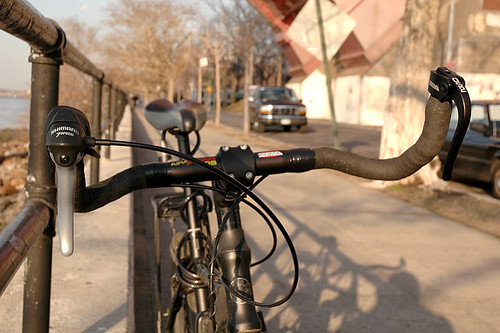
nice story to share about cycling to work...
http://commutebybike.com/2006/03/27/the-new-york-commuter-nick-james/
In late December, the local news began covering the contract dispute between the Metropolitan Transit Authority and the Transit Workers Union, and the possibility of a strike by subway and bus operators. A lot of friends and co-workers were confident that the strike wouldn’t happen, but I wanted to be prepared. On Monday, December 19th, I put on several layers of clothing and some cold weather gear, hopped on my bike, and rode to work. Having proved to myself that I was capable, I concluded that I was prepared for a strike. The next day, the strike was on.
Biking in sub-freezing weather proved easier than I had expected. I anticipated burning wind, icy roads, numb extremities, and other unpleasantries, but learned over a few days of trial and error some of the basic do’s and donts of winter biking, the most important of which was not to overdress, which I did at the start. I also found, somewhat to my surprise, that I enjoyed it. Since you guys at CbB have done a fine job cataloging all the joys of commuting by bike, I won't waste my time listing them. I expect we're all very familiar with them. Suffice it to say that they were new to me.
The transit strike lasted only four days, but it gave me a new resolve. When one transportation option was taken away, I was forced to find another, and the alternative turned out to be the preferable option. So, when the trains started running again, I didn’t get on, and I don't regret it. Commuting by bike has made me stronger, faster, leaner and smarter. It's burned my lungs, strained my knees, torn my rotator cuff, and toughened me up in a hundred little ways. My wife sure likes what it's done to my butt. My co-workers, who at first were impressed and confused, have come to accept it as normal, even to the point of buying bikes and riding to work themselves. Now, having started in the dead of winter, I'm looking forward to the warm weather and sunshine that most cyclists consider "biking season."
I don't think there's anything difficult or special about what I did. Lots of people bike more than 75 miles in a week, and I’m no athlete. Make anything a part of your daily routine and you stop seeing it as a challenge.
I encourage anyone still debating their options to try it out. If it’s not possible, you'll know, but you might surprise yourself.
.....................
more story can be found here
http://commutebybike.com
Thursday, March 16, 2006
Low stress route makes for a joyful bike ride
Joyful? By bicycle? In Singapore? On the roads?? Yes! Let me explain.
My daily ride to work has become a joy since I found a low stress route to take. It takes me mostly along quiet streets. These stretches are linked up by some short off-road short cuts (and a few short stretches of busy roads). Riding to work is now a real pleasure.
The 'short cuts' involve places where I need to dismount to deal with a few steps or clamber up or down a slope. Maybe that sounds annoying but IMHO these inconveniences are a small price to pay to help me avoid the heavy traffic, lorries, noise and fumes of the main alternative route, which includes Alexandra and Pasir Panjang Roads.
You might think all the hassles with short cuts would take more time. But no! The low stress route takes me less than 25 minutes door to door (about 5 or 6 kms). The main road route is shorter and flatter but takes 25 minutes as well, mainly because it has more traffic lights to wait at.
Below I will give details of the route. But first I want to explain why I am sharing this. Why should you be interested in this route if you live nowhere near it?
One reason is to make the point that riding in Singapore is NOT always unpleasant and dangerous. My daily commuting ride is mostly very pleasant, relatively safe and leaves me feeling calm and happy.
Another reason for sharing this is that I hope to encourage you (Singapore cyclists) to share your own useful short cuts. I have often wished for a map of 'secret' ways to avoid dangerous stretches of road when I am out cycling in unfamiliar territory. So much so that I once started to make my own such maps. I might try again if enough people share their short cuts and low-stress bicycle routes! And, at risk of getting carried away with enthusiasm, if we can find and map enough safe routes all over the island, maybe we can persuade the LTA, URA and NParks to improve and protect them and one day link them up into a national bicycle network. Why not?
My route to work
Here is a brief summary of the route. Just the basic facts so you could find it if you wanted to.
- Depot Rd (traffic not too bad usually) turn right (north) into Alexandra Rd (very busy - but on it for a just short stretch)
- turn left (west and up the only serious hill of the trip) into York Rd (in quiet leafy Alexandra Park) (map)
- turn right into Canterbury
- then left into Russels (becomes Winchester)
- then right into small blocked road before Tennis Courts (map)
- left onto grass at the end, dismount, carry bicycles and clamber carefully down steep slope towards AYE. Cross drain - be careful not to fall in! (this bit may put some people off)
- left along 'goat track' that has been worn by pedestrians and bicycles running along AYE (on the safe side of the crash barrier)
- join the Normanton exit from AYE
- at far side of junction dismount and climb steps into Science Park I (at the back of Cintech III) (map)
- turn right into Science Park Drive (some traffic but usually low speed)
- turn left into South Buona Vista (and be careful of the pinch point right near the junction at the star on this map and be wary of the heavy traffic here at peak times)
- continue south along the windy road (by the way, if you instead turn right immediately here you can enter NUS and either ride along the ridge to the Central Library or head down to the Business School past the PGP student accommodation)
- until the first bus stop (you will see a sheltered bus stop on the right for SBS route 200). Cross road (carefully!) and carry bicycle down the stairs into Science Park II (The Gemini) (map)
- turn right into Science Park Rd (down hill - the only serious hill of return trip)
- This takes you to Pasir Panjang Rd, although I turn right again before the Capricorn building to go up to Heng Mui Keng Terrace and my office
The reverse route is more or less the same, but with slightly more inconvenience (walking bike on footpaths in two places for a short stretch rather than ride the wrong way against traffic - which is very very dangerous!).
Please email details of your favourite LOW-STRESS routes and short cuts to sppbpa at nus dot edu dot sg. Please give enough detail so we can find them. I and other friends of 'Cycling in Singapore' blog will try to check them out and then hopefully share them via this blog sometime.
In coming months I will also share some other low stress routes and useful short-cuts that I have found.
Subscribe to:
Posts (Atom)
